Support quietly became one of your biggest line items. SaaS Capital's 2026 survey puts the median spend on support and success at 9% of ARR, up from 8% last year. At $30M ARR, that's $2.7M a year, most of it going to answering the same 40 questions in slightly different words.
So when a vendor promises "80% deflection at $0.99 a resolution," the appeal is obvious.
The arithmetic is not.
Deflection is the wrong number
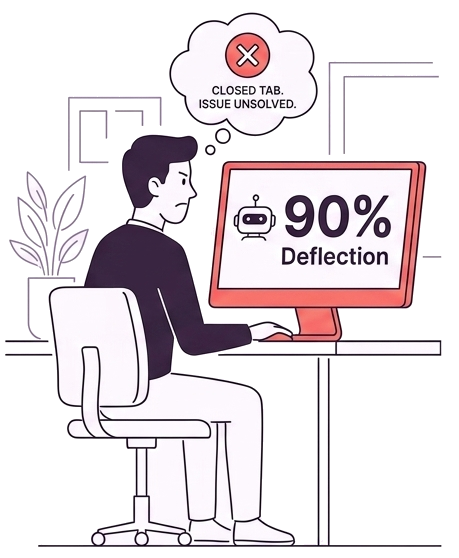
Here's the industry's open secret: deflection counts customers who gave up. If your bot loops someone twice and they close the tab, that's a "deflected" ticket. One major platform's own measurement framework admits a system can show 90% deflection while actually resolving 40% of issues.
The honest numbers look like this: the median B2B SaaS team achieves roughly 22% true automated resolution in year one. Not 80. Best-in-class deployments do reach 55–85%, but only on well-scoped intents, with a healthy knowledge base and an agent that can actually do things, not just answer things.
The pricing has the same problem. That $0.99 sticker lands closer to $5 per resolution all-in once you count connectors, knowledge-base prep, engineering time, and tuning. Here's the thing though: $5 against a $25–45 human ticket is still a 6x win. The honest math doesn't need inflating, which makes you wonder why everyone inflates it.
In B2B, a bad deflection costs more than a ticket
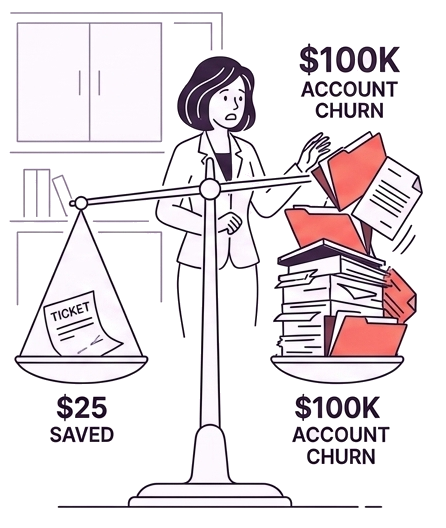
In B2C, a bad bot interaction is an annoyance. In B2B, the unit of risk is the account.
A frustrated admin at a $100K-ARR customer doesn't reopen the ticket. They ping their CSM, mention it to their VP, or say nothing at all — until renewal. Your deflection dashboard stays green the entire time. You saved $25 on a ticket and lost six figures eleven months later, and no metric connected the two.
This is why we think support automation in B2B should be contracted on three things, none of which vendors will sign up for: verified resolution (the problem actually solved, confirmed by no re-contact within five days, not 72 hours), CSAT held flat as a co-primary KPI, and account-value-tiered automation: aggressive on the long tail, careful with strategic accounts, always with a fast, context-rich path to a human.
What actually separates deployments that work
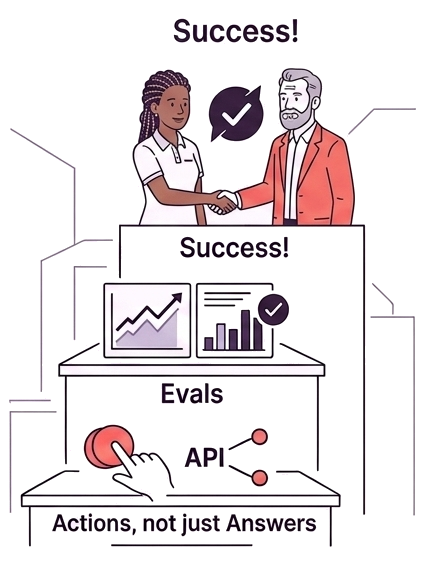
It's not the model. After looking hard at what's live in production in 2026, four things draw the line:
- Knowledge base coverage. If your KB covers 60% of your top intents, your deflection ceiling is 60%. No model fixes that. Most teams discover this after signing the contract.
- Actions, not just answers. Answer-only bots cap out around 25–40%. The deployments hitting 70%+ can process the refund, update the account, trigger the provisioning, through your actual APIs.
- Phased rollout. Suggest-mode first, where humans approve every AI draft. Auto-resolve is earned per intent, with evidence, not switched on globally on day one.
- Evals. Golden datasets built from your real historical tickets — messy phrasing and all — so you know the agent works before it meets a customer, and keeps working after every product release.
How to know it's time
A few signals we see over and over: you just posted a knowledge-manager role whose job description literally says "to power AI-driven support." Your support hiring is scaling linearly with ARR, the exact treadmill AI was supposed to end. Or you already bought Fin or Zendesk AI, it's stuck at 40%, and your security team won't sign off on going further.
If any of those sounded uncomfortably specific — yes, these are exactly the signals firms like ours prospect on. You're already on someone's list. So when the vendor pitches "80% deflection", you negotiate from your own baseline instead of their marketing claim. Better to run the numbers on your own terms.
The gap in the market (it's probably where you're standing)
Enterprise buyers get Sierra and Decagon — excellent, and $200K–$3M with embedded engineering teams. Self-serve buyers get the $0.99 tools. The Series B–D company with 2,000–50,000 tickets a month gets neither: too small for the forward-deployed armies, too complex for plug-and-play.
What's missing is an independent, product-agnostic layer: someone who deploys on Fin, Zendesk, Pylon, or a custom stack, proves it with evals your governance team can sign off, and contracts on the strictest definition of success rather than the most flattering one.
That's the problem we're solving.
Start with the honest number
We run a two-week AI Opportunity Sprint: audit your historical tickets, map intents and volumes, measure your real KB coverage, and hand you a scoped resolution target with an ROI model built on your numbers (the $5 all-in cost, not the $0.99 fantasy). Fixed fee. If the math says "don't automate yet, fix your knowledge base first," that's what the report will say.
Do it before you sign anything with anyone. Including us.
We deploy Tier-1 support agents for B2B SaaS, contracted on verified resolution, CSAT held flat.